Log 004 — Oct 27, 2026
DJ decks on the Studio
Studio v1.6 adds two DJ decks, played from a Hercules controller and read from your Serato tags. SLOOP and X0X now play together, in time.
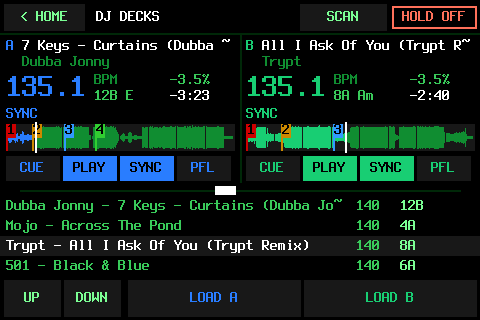
The Studio is a DJ rig now. Studio v1.6 adds two DJ decks, played from a Hercules DJControl Inpulse 200 MK2 and the Studio’s touchscreen. Open them from MORE › DJ DECKS.
Your music, your Serato prep
Drop tracks in the Studio DJ Music folder (MP3, FLAC, WAV, AIFF or Ogg) and tap SCAN. It reads each track’s title, artist, BPM, key and beatgrid from its tags, including what Serato DJ already saved in your MP3s: BPM, key, beatgrid and hot cues. So the cues you set in Serato are on the pads. Where the tags don’t have them, the Studio works out the BPM, key and beat from the sound itself.
We checked that against Serato’s own analysis of a 37-track crate. The Studio found the same BPM on 32 tracks (36 counting double or half tempo) and the same key on 26. Scanning all 37 took about six minutes on the Pi 3.
Two decks, the controls you’d expect
- CUE as on a CDJ, a ±8 % tempo fader, and the jog wheel to nudge, search or scratch.
- Four hot cues, loops you can halve or double, and loop rolls on the pads.
- Gain, low and high EQ, a filter, the channel faders and the crossfader.
- SYNC that holds the beat, not just the tempo: a synced deck stays on the other’s beat while both play, at double or half tempo when that’s nearer. Each track’s beatgrid is lined up with its own kicks when it loads, so two synced tracks hit together.
- PFL in your headphones through the Hercules’s own headphone out, with the master on the Studio’s Bluetooth speaker.
- It remembers your hot cues and cue points per track, and brings the decks back loaded and paused where you left them. Your music files and their Serato tags are never changed.
All of it was played by hand on the real Studio with the Hercules. With both decks running, they use about 45 % of one of the Pi 3’s four cores.
Not built yet: the FX and SAMPLER pad modes, key lock (a faster track sounds higher), and the decks as a MIXER channel or in the recorder. Not tried yet: the decks without the Hercules, a long set, and the decks next to SLOOP or X0X.
SLOOP and X0X, together and in time
The Studio’s SLOOP and X0X no longer take turns. One is on the screen while the other keeps playing behind it, and both run on one MIDI clock: SLOOP leads by default, so PLAY on SLOOP starts both from the top. This was tried by hand from FM-1 A. Each now has a CUE button in the MIXER too.
The Studio’s SLOOP also keeps everything an FM-1’s SLOOP keeps (projects, slots, presets, samples), and the
Companion backs it up and restores it the way it does an FM-1, so a backup of a real FM-1 restores onto the
Studio. X0X backs up to its own .x0b format. The backups were tested by script on the Studio, not yet by hand.
The full list of what’s been tried and what hasn’t is in the Companion’s README. Not affiliated with Serato or Hercules.